
Pīpīwai TrailOn the trail
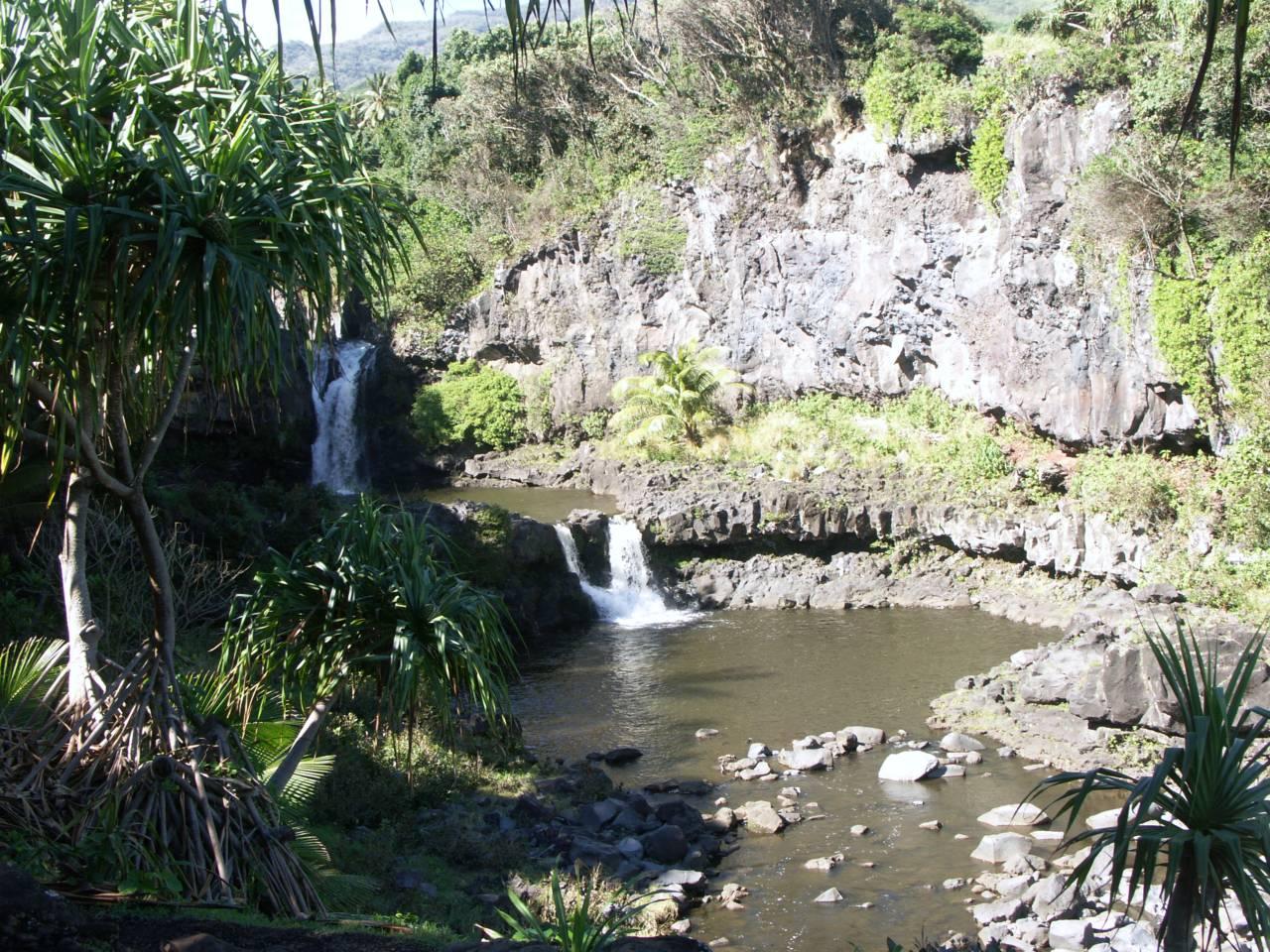
Seven Sacred Pools Maui
Last checked 2026-08-23
Didier B (Sam67fr), CC BY-SA 3.0, via Wikimedia Commons
Closed to swimming. The NPS conditions page, last checked 2026-08-23, lists the pools as "not accessible for swimming" and says they can be viewed from the Kūloa Point Trail. The Seven Sacred Pools are properly ʻOheʻo Gulch — there are not seven of them and they were never sacred, both are marketing names from the tourism era. They step down a stream bed to the ocean at the bottom of the Kīpahulu District. The Kūloa Point Trail is 0.5 miles from the same parking lot the Pīpīwai Trail leaves from, and the walk drops 80 feet to the coast overlook. Half an hour, and worth the half hour.
| Name you searched | What it is |
|---|---|
| Seven Sacred Pools | A marketing name from the tourism era. Not seven, not sacred, still the name everyone uses. |
| ʻOheʻo Gulch | The gulch itself, and the name the park and local families use. |
| Pools of ʻOheʻo | The pools in that gulch. Closed to entry, verified 2026-02-11. |
| Kūloa Point Trail | 0.5 mi, 80 ft down and back up, the walk that gets you the view. |
| Pīpīwai Trail | 4 miles the other direction, inland and uphill to Waimoku Falls. Not the pools. |
Pīpīwai stops in this district
- 1
0.5 mi · First waterfall view
- 2
~1 mi · Boardwalks and footbridges
- 3
2 mi one way · 400 ft falls
Can you swim in the Seven Sacred Pools?
No. The NPS conditions page, checked 2026-02-11, says the pools are "not accessible for swimming." The view is from the Kūloa Point Trail, which ends at the gulch overlook above the tiered pools. Nobody stops you at a gate. There is a sign, and a low fence in places, and beyond that it is on you. Rangers do write citations here, but that is not really the argument.
Three hazards closed this water. Flash flooding from the upper watershed arrives without warning at pool level. Active rockfall above the upper ledges is quiet enough that moving water covers the sound of it. The lowest pool exits toward open surf with no easy exit from it. Those are the reasons the language is about swimming rather than any temporary condition under repair.
Are the 7 sacred pools on the Pīpīwai Trail?
No, and this is the single most common mix-up in the district. Both walks start from the same lot and split at the same signpost 0.1 miles in, beside Hale Hālāwai. Left and uphill is Pīpīwai, 4 miles round trip through the bamboo to a 400-foot waterfall. Right and downhill is the Kūloa Point Trail, which reaches the coast in about ten minutes.
The two trails share an entrance fee, a parking lot, and nothing else. Pīpīwai climbs 800 feet inland and never comes near the pools. Kūloa Point never goes uphill at all. If you are standing at a railed overlook looking across a gulch at a tall thin waterfall, you took the Pīpīwai fork and you are at Makahiku, which is a fine place to be but is not what you searched for.
Why are they called the Seven Sacred Pools?
Because it sold trips. The name was attached to this gulch during the era when the Hāna coast was being marketed to visitors, and it stuck so hard that it now outranks the real name in search by a wide margin. There is no Hawaiian tradition that set these particular pools apart as sacred, and the park does not use the phrase in its own signage.
The count is wrong too. ʻOheʻo steps down through more pools than seven on its way to the sea, and how many you can pick out depends on how much water is coming down that week. In a wet month the smaller ones merge into one moving sheet. In a dry one you can count well past seven.
What is the walk to Kūloa Point actually like?
Easy, short, and completely different in character from Pīpīwai. It is 0.5 miles on a wide graded surface, mostly mown grass and packed dirt, dropping 80 feet toward the water on a grade you barely register. Most people are out and back in half an hour, and that includes standing around. There is no mud problem, no boardwalk, no stairs, and no roots to catch a toe on.
That makes it the accessible option in this district, and the honest answer for anyone travelling with a stroller, a wheelchair, a bad knee, or a group that will not enjoy four miles of wet stone. It is not certified accessible end to end and the last stretch onto the point is uneven, but a great many people who cannot do Pīpīwai can do this.
What you get at the end is the gulch on one side, stepping down in ledges and pools, and open ocean ahead with the surf working the black rock below. It is windy out there almost always. Sit for ten minutes, because the pools look different as the light moves.
What else is on the Kūloa Point trail?
More than the view, and it is the part nobody mentions. This trail crosses a landscape that was farmed and lived on for centuries, and the stone walls and terraces in the grass on both sides are not landscaping. Loʻi walls, house platforms, and field boundaries. They are protected archaeological sites, so walk around them and leave stones where they are.
Partway along the trail the park maintains a Hawaiian cultural demonstration area, used for programs when staff and community practitioners are on site. Back at the fork stands Hale Hālāwai, a reconstructed Hawaiian meeting house near the trailhead fork. Rangers give short talks down here, so if a program is posted at the visitor center it is worth an extra twenty minutes of your day.
Why are the pools closed to swimming?
Three hazards, all of them specific to this gulch. The first is flash flooding. ʻOheʻo Stream drains slopes that run for miles up toward the summit, and rain falling up there in weather you cannot see from the coast arrives at the pools as a fast brown surge carrying rock and wood. It can be bright and dry where you are standing while the water is already rising.
The second is rockfall from the walls above the upper pools, quiet enough that moving water covers the sound of it. The third is the ocean. The pools sit a short distance above open surf, and a swimmer pushed out of the lowest one is in the water against black rock with no easy exit. People have drowned here.
The line the park quotes for this water is he wai makamaka ole, water recognizes no friend. It is not decoration. Stream entry anywhere in Kīpahulu is not recommended, and emergency care from here is more than 1 hour away with no cell signal to summon it.
When did the Seven Sacred Pools close, and will they reopen?
The pools were closed to swimming in 2018 following a rockslide above the upper pools that prompted NPS safety enhancements. They briefly reopened, then closed again in 2020. They have not reopened for swimming since. As of 2026-02-11, the NPS conditions page lists the pools as "not accessible for swimming" with no reopening date posted.
The three hazards that drive the closure are structural features of the site, not temporary conditions under repair. Flash flooding from the upper watershed arrives without warning. Active rockfall above the pool ledges is ongoing. The lowest pool exits directly toward open ocean surf. A future reopening is possible — the pools were accessible for years before 2018 — but there is no indication one is imminent.
The pool viewing from the Kūloa Point Trail is not affected. You walk to the gulch, see the pools step down through it, and watch the stream move. That part of the district is open and worth the half mile.
Can you do both trails in one visit?
Yes, and most people should. One 3 day pass at $30 per vehicle covers both trails and they leave from the same lot. Budget 2.5 to 3.5 hours for Pīpīwai and about 27 minutes for Kūloa Point.
Do Pīpīwai first. It is cooler early, the afternoon rain tends to arrive later, and Kūloa Point is short enough to be a reward rather than a chore on tired legs. The visitor center is open 9am to 5pm, staffing permitting and the lot gates close at 5pm, so arriving by early afternoon leaves room for both.
Questions
- Can you swim in the Seven Sacred Pools?
- No. The NPS conditions page (checked 2026-02-11) says the pools are "not accessible for swimming." View them from the Kūloa Point Trail.
- Are the 7 sacred pools on the Pipiwai Trail?
- No. They are on the Kūloa Point Trail, which branches the opposite way from the same signpost 0.1 miles from the parking lot and drops to the coast. Pīpīwai goes inland and uphill to Waimoku Falls.
- Why are the Seven Sacred Pools closed?
- Flash flooding from rain miles uphill, active rockfall above the upper pools, and drownings in the surf below the lowest one. NPS conditions page: "not accessible for swimming."
- Are the Seven Sacred Pools open in 2026?
- Closed to swimming. NPS conditions page last checked 2026-02-11: "not accessible for swimming," no reopening date posted. You can view them from the Kūloa Point Trail.
- When will the Seven Sacred Pools reopen?
- No reopening date posted as of 2026-02-11. The pools closed to swimming in 2018 after a rockslide and have not reopened. The hazards — flash flooding, active rockfall, and ocean surge at the base — are permanent features of the site, not temporary conditions under repair.
- Are there really seven sacred pools?
- No. There are more than seven, the number changes with the water level, and nothing in Hawaiian tradition marked them as sacred. The name came out of tourism promotion for the Hāna coast.
- How long is the Kuloa Point Trail?
- 0.5 miles round trip with 80 feet of drop and climb, about half an hour at an unhurried pace on a wide graded surface.
- Are the Seven Sacred Pools worth visiting if you cannot swim?
- Yes, for half an hour. It is the easiest walk in the district, it ends at an ocean overlook with the gulch beside it, and the archaeological sites along the way are the part most visitors miss.
Sources: https://www.nps.gov/hale/planyourvisit/conditions.htm · https://www.nps.gov/places/pools-of-oheo.htm · https://www.nps.gov/hale/planyourvisit/hiking.htm · https://www.nps.gov/hale/planyourvisit/kipahulu.htm · https://www.nps.gov/hale/planyourvisit/kipahulu-district.htm